Why Betelgeuse Keeps Dimming: New Clues About a Dying Supergiant
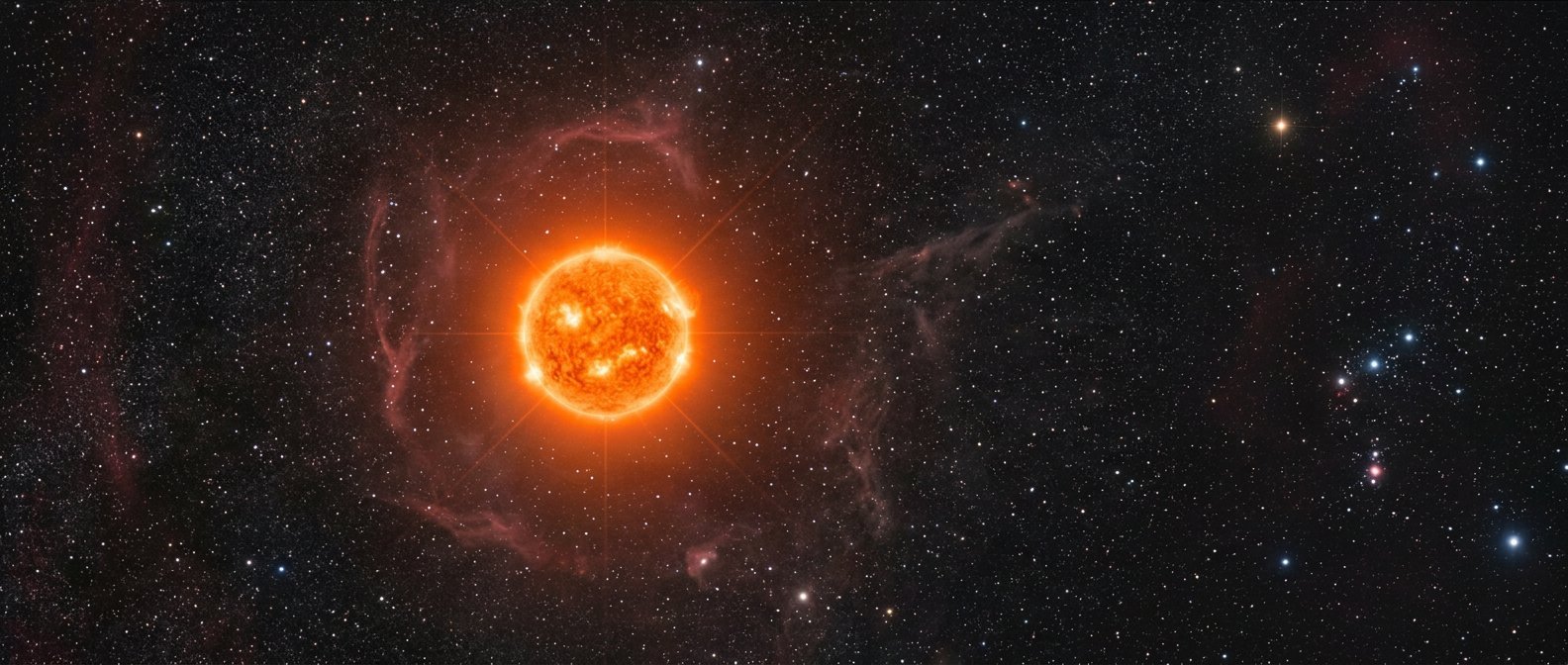
Betelgeuse is one of the most recognisable stars in the night sky — the bright red shoulder of Orion. It is also a star nearing the end of its life, and its repeated dimming episodes have made it a natural laboratory for studying how massive stars behave in their final stages.
During the "Great Dimming" of 2019–2020, Betelgeuse lost more than two-thirds of its usual brightness, prompting speculation that a supernova was imminent. Careful follow-up showed something subtler and, arguably, more interesting.
Dust, not doom
High-resolution imaging revealed that a huge bubble of gas was ejected from the star's surface. As this material cooled, it condensed into dust that temporarily blocked our view. The Betelgeuse dimming was therefore a window into the violent mass-loss process that red supergiants undergo before collapse.
Boiling on a colossal scale
Betelgeuse's surface is covered by convection cells so large that a single one can span a significant fraction of the star. When an unusually strong upwelling coincides with the star's pulsation cycle, gas can be launched outward — exactly the mechanism thought to have triggered the 2019 event.
A star like Betelgeuse doesn't simply explode one day; it spends millennia shedding itself into space first.
When will it explode?
Most models still place the supernova tens of thousands of years in the future — soon on cosmic timescales, but not something to schedule your evening around. When it does happen, Betelgeuse will briefly rival the full Moon in brightness.

Dr. Ahmed Raza
Astrophysicist · Stellar Evolution
Dr. Ahmed Raza studies the late evolutionary stages of massive stars and supernova progenitors. His work combines spectroscopic surveys with 3D hydrodynamic simulations to understand how red supergiants lose mass before … View portfolio →
💬 Comments (1)
Great research article!