Neutron Star Collisions: Where the Universe Forges Gold
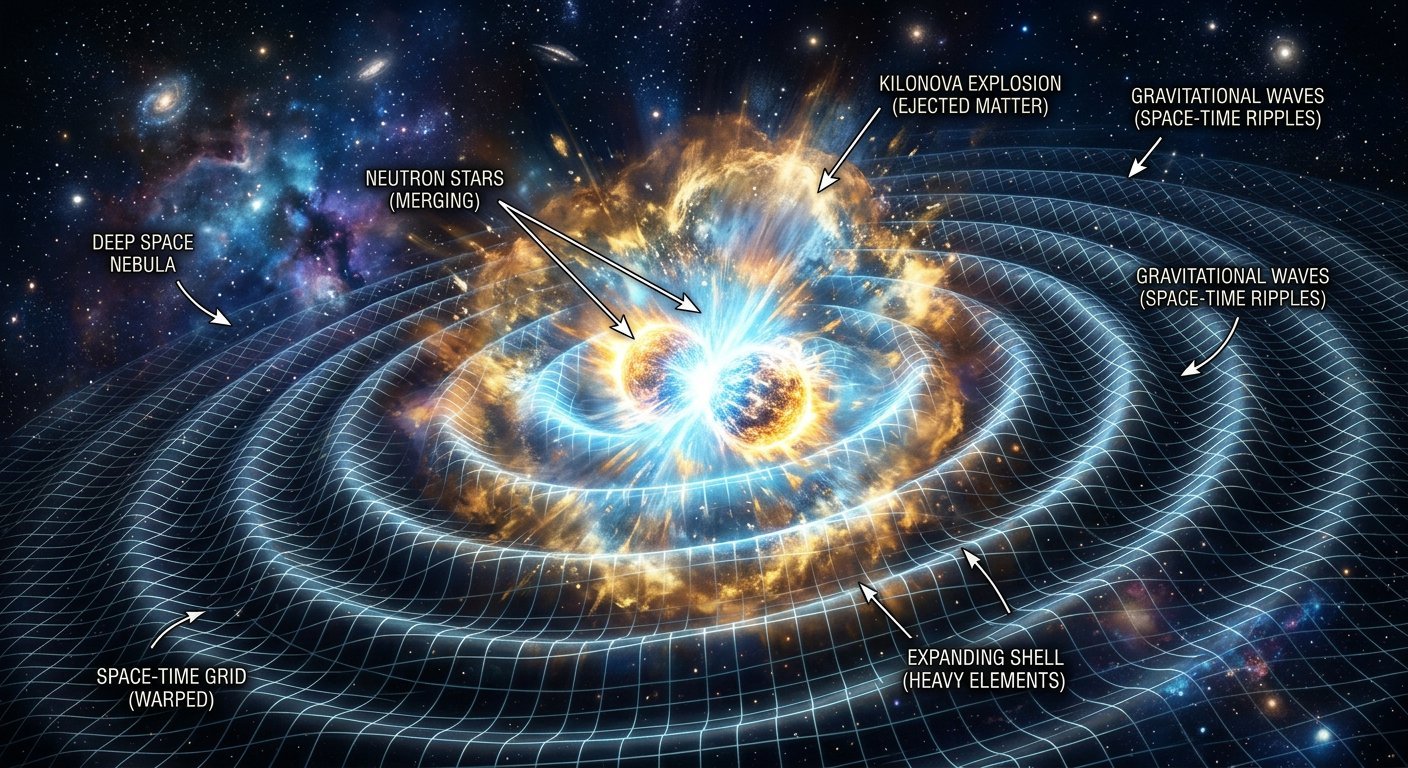
In 2017, detectors on two continents felt a tremor in space-time: the first observed neutron star merger, GW170817. Seconds later, telescopes caught the glow of a kilonova — the radioactive fireball where some of the universe's heaviest elements are made.
A neutron star packs more mass than the Sun into a sphere the size of a city. When two of them spiral together, the final collision ejects neutron-rich material at a tenth of the speed of light.
The r-process
In that ejecta, atomic nuclei capture neutrons faster than they can decay — the rapid neutron-capture process, or r-process. This is how nature builds gold, platinum, and uranium. A single neutron star merger can produce several Earth-masses of gold.
Multi-messenger astronomy
GW170817 marked the beginning of multi-messenger astronomy: the same event observed in gravitational waves, gamma rays, visible light, and radio. Each messenger tells a different part of the story, from the physics of ultra-dense matter to the expansion rate of the universe.
Future detector upgrades should let us catch dozens of these events every year, turning cosmic gold factories into routine science.

Dr. Ahmed Raza
Astrophysicist · Stellar Evolution
Dr. Ahmed Raza studies the late evolutionary stages of massive stars and supernova progenitors. His work combines spectroscopic surveys with 3D hydrodynamic simulations to understand how red supergiants lose mass before … View portfolio →
💬 Comments (0)